There are days when numbers feel like they’re floating in the air, not really touching anything real. Someone says “5 inches” and you nod like you understand, but deep down your brain is like… wait, how big is that actually? It’s one of those measurements that slips between imagination and reality, kinda like trying to remember the exact taste of rain.
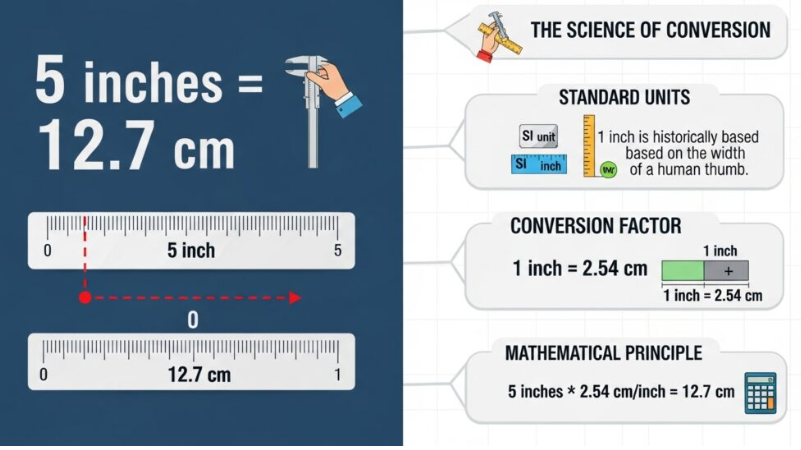
Now funny thing is, 5 inches (measurement concept) is not huge, not tiny either. It sits in that awkward middle zone where your brain guesses wrong more often than not. In real terms, it equals 12.7 cm (centimeter equivalent), which already sounds more “scientific” and less emotional somehow.
The moment you switch between systems, you’re stepping into the world of Imperial system vs metric system, where everything suddenly feels like it belongs to different universes.
And honestly, people don’t usually walk around measuring things with rulers in their head. Instead, we compare. We visualize. We say “oh that’s about the length of my phone” or “it’s like half a dollar bill” and hope for the best.
That’s where this whole idea gets interesting because learning how big is 5 inches visually is less about math and more about memory, objects, and everyday life doing the teaching for us.
| # | Object | Approx. Size Note |
|---|---|---|
| 1 | Credit card | Very close visual length reference |
| 2 | Dollar bill | Slightly longer in some comparisons, but close visual match |
| 3 | Popsicle stick | Nearly standard 5-inch length |
| 4 | Small notepad | Pocket-size versions often around 5 inches |
| 5 | Mini stapler | Compact desk model size |
| 6 | Compact ruler | Half rulers often ~5 inches |
| 7 | Smartphone (small models) | Screen height/diagonal feels similar |
| 8 | Coin purse | Palm-sized accessory |
| 9 | Perfume atomizer | Travel spray bottle size |
| 10 | Soap dish (small) | Bathroom compact version |
| 11 | Picture frame (mini) | Desk photo frame size |
| 12 | Alarm clock (mini) | Travel desk clock size |
| 13 | Hair barrette (large) | Decorative longer clips |
| 14 | Toilet paper roll (diameter reference) | When laid sideways, close visual comparison |
Understanding 5 inches in cm and the science behind conversion

If we strip everything down, measurement is just a shared agreement between humans. According to standard systems like those maintained by the NIST (measurement authority reference), the rule is simple: 1 inch = 2.54 cm. That means converting is just multiplication, nothing mystical… but still feels a bit magical when you do it.
So when you ask for 5 inches in cm, the answer becomes:
5 × 2.54 = 12.7 cm
That’s your clean number. But real life is rarely clean.
We also deal with Millimeters (mm) when precision matters, or Feet (ft) when things get bigger, or Meters (m) when we start talking buildings and roads. But for small everyday comparisons, 5 inches sits comfortably in the “handheld world.”
This is where Inch to centimeter conversion becomes more than just a formula. It becomes a mental habit. Like when you’re doing everyday measurement comparison while shopping online and thinking, “will this fit on my desk or nah?”
A lot of people also rely on DIY measurement approximation when they don’t have tools. You know, using fingers, palm width, or random objects lying around. It’s not always precise, but it builds a kind of spatial awareness training in your brain over time.
And yeah, even designers think about this stuff. Products are often built with ergonomics and design sizing in mind, meaning 5 inches isn’t random—it often shows up as a sweet spot for comfort and portability.
5 inches in your pocket: office and stationery objects
Now let’s move from theory to desk life. Because honestly, your workspace is probably already full of things that are roughly 5 inches long, even if you never noticed.
Here are some common office and stationery items that quietly match this size range:
- A small notepad size often sits close to 5 inches in height or width, especially pocket versions
- A mini stapler that fits in your palm without drama
- A compact ruler, especially half-sized versions used in travel kits
- A desktop alarm clock in mini form, the kind that sits beside your laptop
- A stack of Post-it notes, which often align closely when stacked neatly
- A paperweight that’s small enough to move with one hand
- A small picture frame meant for desk memories
- A small notepad again shows up here because, well, they’re everywhere and oddly consistent in size
These objects quietly train your brain in object dimension estimation, even when you’re not trying.
There’s something interesting here: once you start noticing, you can’t unsee it. A colleague once said (bit dramatically maybe), “I never understood 5 inches until I realized it’s basically my sticky notes stacked sideways.” Not scientifically perfect, but emotionally correct.
And that’s the thing about visual measurement reference objects they don’t need to be exact, just familiar.
5 inches around the home: decor and everyday comfort objects

Now let’s wander into the home space, where measurement becomes softer and more decorative.
Homes are full of objects designed with household item standard sizing in mind, meaning many things naturally land around the 5-inch zone without you ever thinking about it.
Here are some common ones:
- A ceramic bud vase, usually short and wide for single flowers
- A soap dish, especially compact bathroom versions
- A decorative hourglass, small enough to sit on a shelf
- A bar soap dish in travel or minimal design sets
- A small picture frame used for bedside memories
- A paperweight shaped like glass or stone
- A tiny storage tray for keys or coins (often similar sizing even if shape differs)
These items are part of home organization sizing guide thinking, even if you never planned it that way.
Culturally, small decorative objects are often used to represent intimacy. In some homes in South Asia, for example, tiny vases or framed photos are placed near entrances as symbolic gestures of warmth. A local artisan once said something like, “Small things don’t shout, but they stay longer in memory.” Not sure if that’s a quote you’d find in a book, but it sticks.
And yeah, most of these objects hover around 12.7 cm, which again brings us back to that quiet conversion number hiding behind everything.
Fashion, tech and personal items that sit around 5 inches
This part gets interesting because now we’re in the zone of things people actually carry, touch, and use daily.
Here, product size comparison online shopping becomes important. People often misjudge sizes while browsing, and suddenly what looked “cute and small” online turns into something way bigger or smaller than expected.
Here are common 5-inch-ish items:
- A coin purse, usually palm-sized and flexible
- A jewelry pouch, small enough to disappear in a handbag
- A hair barrette in larger decorative designs
- A perfume atomizer, travel-sized for convenience
- A smartphone (screen diagonal reference) many compact phones or screen measures hover around this range in feel
- A credit card stack length comparison (a single card is smaller, but stacked visual width helps estimation)
- A foam roller (fitness / paint roller cover) in mini versions used for travel or therapy
This is where portable tool design optimization really shows up. Everything is built to fit pockets, bags, or minimal storage space.
People often underestimate these sizes when thinking about packing and travel sizing. Then they end up repacking at airports, slightly confused, slightly annoyed, and definitely rethinking their “I don’t need a bigger bag” decision.
It’s also where real world scale reference becomes useful. Because 5 inches is small enough to be portable, but large enough to matter in design decisions.
14 common things that are 5 inches long (real-world list)

Now let’s put everything together clearly. These are 14 common things that are 5 inches long, give or take a bit depending on brand or design variation. Think of this as a loose but practical size comparison guide for everyday life:
- A standard dollar bill (length approximation depending on region variation in visual comparison use)
- A typical credit card
- A wooden popsicle stick
- A small notepad
- A mini stapler
- A compact ruler
- A desktop alarm clock in mini format
- A small picture frame
- A ceramic bud vase
- A soap dish
- A coin purse
- A perfume atomizer
- A foam roller cover (mini fitness version)
- A toilet paper roll diameter (approx visual reference when laid sideways)
Each of these helps build a mental model of everyday measurement comparison, which is honestly more useful than memorizing numbers alone.
Once you start mapping objects like this, your brain kind of builds its own internal ruler. Not perfect, but surprisingly effective for estimating size without ruler situations.
And yeah, sometimes people argue about exact lengths online someone will say “that’s not 5 inches exactly!” and technically they might be right. But in real-world size visualization, precision often takes a back seat to usefulness.
Why understanding 5 inches actually matters more than it sounds
At first glance, learning about something like 5 inches might feel unnecessary. But in reality, it connects to so many practical things shopping, DIY work, cooking measurements, even furniture spacing.
When you understand online shopping size interpretation, you make fewer mistakes buying gadgets or home items. When you get comfortable with imperial to metric conversion, international products stop feeling confusing. And when you start comparing things mentally, your sense of space improves naturally.
This is also where real-world measurement examples become powerful learning tools. Instead of memorizing formulas, your brain remembers a coin purse, a stapler, or a popsicle stick.
There’s also a subtle cognitive benefit better spatial awareness training. You begin to estimate distances, gaps, and sizes more intuitively. Even things like arranging furniture or packing a bag start feeling easier.
A teacher once said (I’m paraphrasing a bit), “If you can visualize 5 inches without a ruler, you’ve already won half the battle of measurement learning.” Sounds simple, but kinda true.
Frequently Asked Questions
how long is 5 inches
5 inches is equal to 12.7 centimeters. It is roughly the length of a small notepad or the width of an average smartphone screen.
how big is 5 inches
5 inches is a small to medium length measurement. It is about the size of a compact stapler or a small desk accessory.
things that are 5 inches
Common items around 5 inches include a small notepad, mini stapler, coin purse, soap dish, and decorative hourglass.
5 inches comparison
5 inches can be compared to a U.S. dollar bill minus about one inch. It is also close to the length of many smartphone screens diagonally.
how long is 5″
5 inches (5″) equals 12.7 cm or 127 mm. It is approximately one-third of a foot in the imperial system.
Read this Blog: https://nexovates.com/that-are-5-inches-long/
Final thoughts: turning measurement into memory
So after all this, how long is 5 inches? It’s not just 12.7 cm, not just a conversion from inch to centimeter conversion, and not just a number sitting in a textbook.
It’s a credit card. A popsicle stick. A tiny alarm clock glowing on a nightstand. A coin purse lost somewhere in a bag. A small piece of everyday life quietly teaching you scale without ever announcing itself.
Once you start noticing these patterns, measurement stops feeling like math and starts feeling like memory.
And maybe that’s the real trick turning abstract units into lived experience.
If you ever catch yourself guessing sizes again, just look around. Your environment is already full of rulers pretending to be ordinary objects.
And honestly, that’s the beautiful part of it all.